



Through our work with a diverse range of clients and investors, we encounter numerous stories that are truly worth sharing. Caleb B. Bell III, PhD, is one such investor and collaborator with a noteworthy story. With a doctorate in biophysical chemistry from Stanford University, Caleb has spent decades as both an entrepreneur and investor, cultivating a unique perspective that bridges the gap between scientific discovery and commercial application.
Today, Caleb is a key figure within Corundum, an international innovation group focused on investing in life-changing companies at the forefront of science and technology, with a focus on pioneering advancements in human health and biology. He serves as a venture partner at Corundum Systems Biology (CSB), an investment arm of Corundum with a key area of interest in microbiome research and development. He’s also the president of the non-profit Corundum Convergence Institute (CCI), which focuses on funding early-stage scientific research in the fields of neuroscience, systems biology, and artificial intelligence.
One of the driving forces behind Corundum’s involvement in microbiome research is their Human Phenotype Project, which aims to profile about 100,000 participants and record their phenotypic changes over 25 years. The study is looking to understand how genetics, environment, and other factors affect our health.
There is a growing recognition of the microbiome’s essential role in our overall health and its influence on various physiological processes, making it an enticing area for research and investment.
We spoke with Caleb recently to get his outlook on the future of the microbiome industry.
Is the microbiome repeating the trajectory of the cell and gene industry?
While microbiome research has faced challenges in the past, it offers far greater potential benefits for overall human health and well-being. Similarly, around 20 years ago, the genetics industry faced comparable obstacles, including the translation of genome discoveries into therapeutics, unknown regulatory pathways, long development timelines, and high costs.
The first human genome sequence, that the Human Genome Project generated between 1990 and 2003, was instrumental in advancing the understanding of human genetics. This groundwork enabled the development of CRISPR-Cas9 gene-editing, advanced gene sequencing and bioinformatics technologies. It gave rise to an entire industry of cell and gene therapies that can treat a wide range of diseases.
Fast-forward to 2024. To date, the FDA has approved over 20 cell and gene therapy products, including the first CRISPR-based therapeutic, with approximately 4,002 gene, cell, and RNA therapies currently in development. In under 20 years since the completion of the Human Genome Project, we have witnessed a remarkable transformation from genome sequencing to a steady increase in new cell and gene therapies.
Microbiome and cell and gene therapies share the common ground of being ‘living therapeutics,’ utilizing living cells and microorganisms to diagnose, treat, or cure disease. Since they’re similar, solutions developed for the cell and gene therapy field can be applied to the field of microbiome-based therapy. This includes solutions of technology, clinical trial design, manufacturing processes, collaboration, and navigating regulatory approval. Advancements in the cell and gene industry, such as DNA sequencing, bioinformatics, and research networks, are directly contributing to microbiome research today and fueling its rapid development.
Leveraging the contributions of the microbiome
Caleb acknowledged the challenges in the microbiome field but remains optimistic. “Thanks to recent advances in big data/AI, genetic sequencing, and systems biology approaches such as the Human Phenotype Project that Corundum is actively supporting – this will be the century of the microbiome!”
Similar to human genome research, which fueled the development of the cell and gene industry, the Human Microbiome Project (HMP), launched in 2007 by the National Institute of Health (NIH), intended to create a comprehensive reference dataset of the human microbiome and investigate its relationship to various health conditions.
The HMP created a comprehensive database cataloging microbial species, identified unique microbial communities specific to various body sites, and established data linking microbes to various conditions (diabetes, obesity, autoimmune disease, and others). By 2017, scientists had sequenced over 3,000 isolate microbial genomes and published over 650 scientific papers that had been cited over 70,000 times.
The insights from the HMP have since spurred additional studies, setting a foundation for ongoing research in the human microbiome.
Caleb served as a panelist in several microbiome conferences this year and noted the diversity of microbiome applications that are currently in development:
- Connection between microbiome and oncology.
- Women’s health.
- Human and bacterial viruses.
Several interesting studies were presented at the conferences describing microbiome applications in cancer treatment, with insights from Sidekick Bio; understanding of social behavior, as demonstrated in Omry Koren’s research; and studies of public health and infectious disease control, including work by Ye Peng of the Chinese University of Hong Kong.
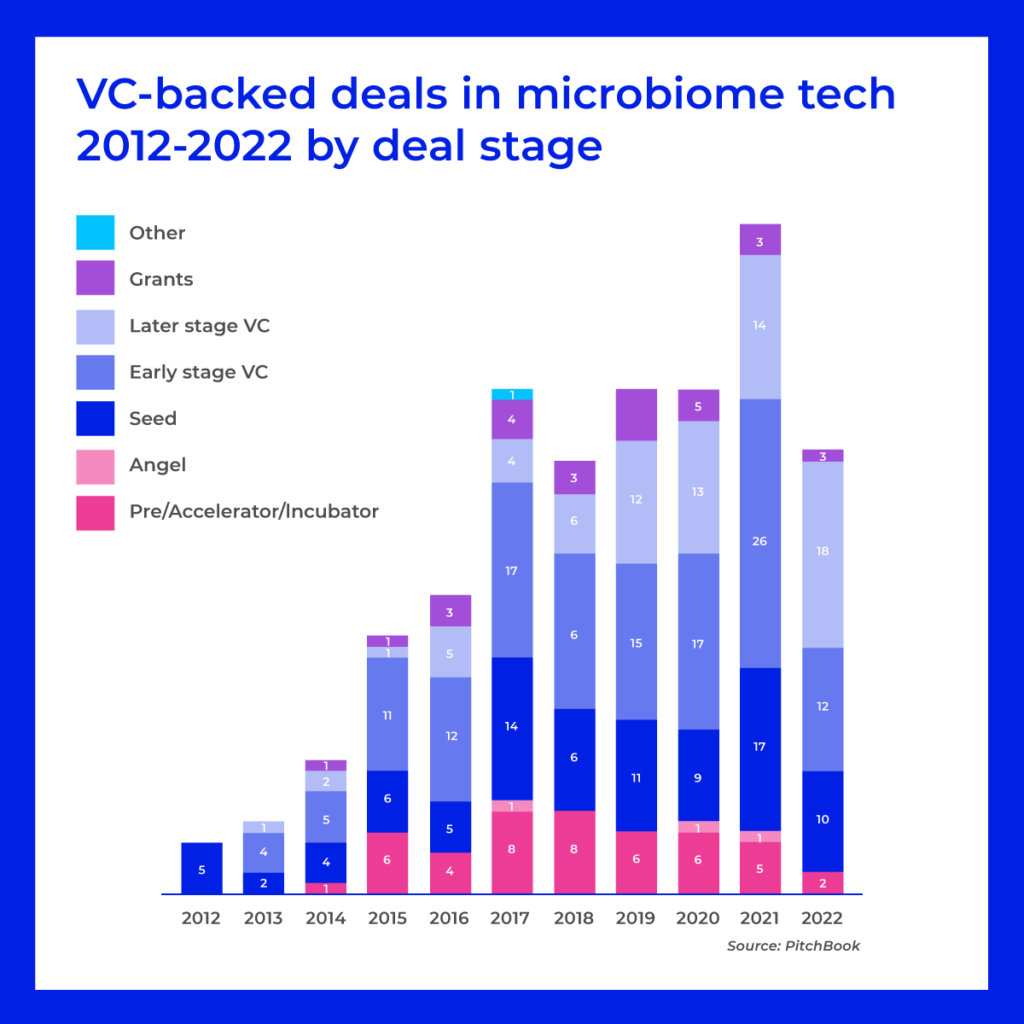
In the past two years, the FDA has approved two microbiome-related products and globally, about 300 active microbiome-related trials are listed on ClinicalTrials.gov. An article published in August 2023 reported investment trends in the microbiome industry over time, including a graph of VC-backed deals illustrating a recent growing interest in the microbiome sector.
Conclusion
Microbiome and cell and gene therapies share the common ground of being “living therapeutics,” utilizing living cells and microorganisms to diagnose, treat, or cure disease. Human cell and gene therapies have paved the way for innovative living therapeutics. With its immense genetic diversity still being defined, the microbiome presents an even more expansive and largely untapped opportunity. While significant hurdles remain, Caleb anticipates the lessons learned and precedents set by cell and gene therapies will significantly accelerate the maturation of the microbiome therapeutics industry.
About Theoria Creative
Theoria Creative is a marketing firm, enabling life sciences companies to clearly communicate complex science to investors, partners, and peers. We develop communication strategy, messaging, positioning, and prepare a set of illustrated materials that help companies clearly and succinctly articulate their value at high stakes meetings.
View examples of our client work here.
Follow us on LinkedIn. Subscribe to our news.
About Corundum Group
Corundum Group is an international innovation group focused on investing in companies at the forefront of science and technology, with a focus on pioneering advancements in human health and biology. Corundum Systems Biology (CSB) is an investment arm of Corundum with a key area of interest in microbiome research and development. Corundum Convergence Institute (CCI) is another arm of Corundum that focuses on funding early-stage scientific research in the fields of neuroscience, systems biology, and artificial intelligence.