



Approximately 25% of individuals aged 25 and above may face a stroke during their lifetime. (WSO) Strokes can result from a blocked artery, also known as Acute Ischemic Stroke (AIS), causing severe brain damage, disability, or death. (CDC).
Since 1987, only one FDA-approved drug, a thrombolytic agent, has been used to treat patients admitted to the hospital with AIS. More than thirty years later, we are still waiting for a breakthrough. (FDA and NIH)
What is an Acute Ischemic Stroke?
Approximately 87% of all strokes are ischemic strokes (ASA), making it the most common type of stroke. They are considered a severe medical emergency that requires urgent care to limit brain damage. Obstruction of a cerebral blood vessel prevents the area of the brain from receiving oxygen and essential nutrients. Consequently, brain cells begin to die, which can result in brain injury, disability, or, in severe cases, death. (NHS) (ASA). The longer the patient remains untreated, the more likely permanent brain damage and disabilities will occur.
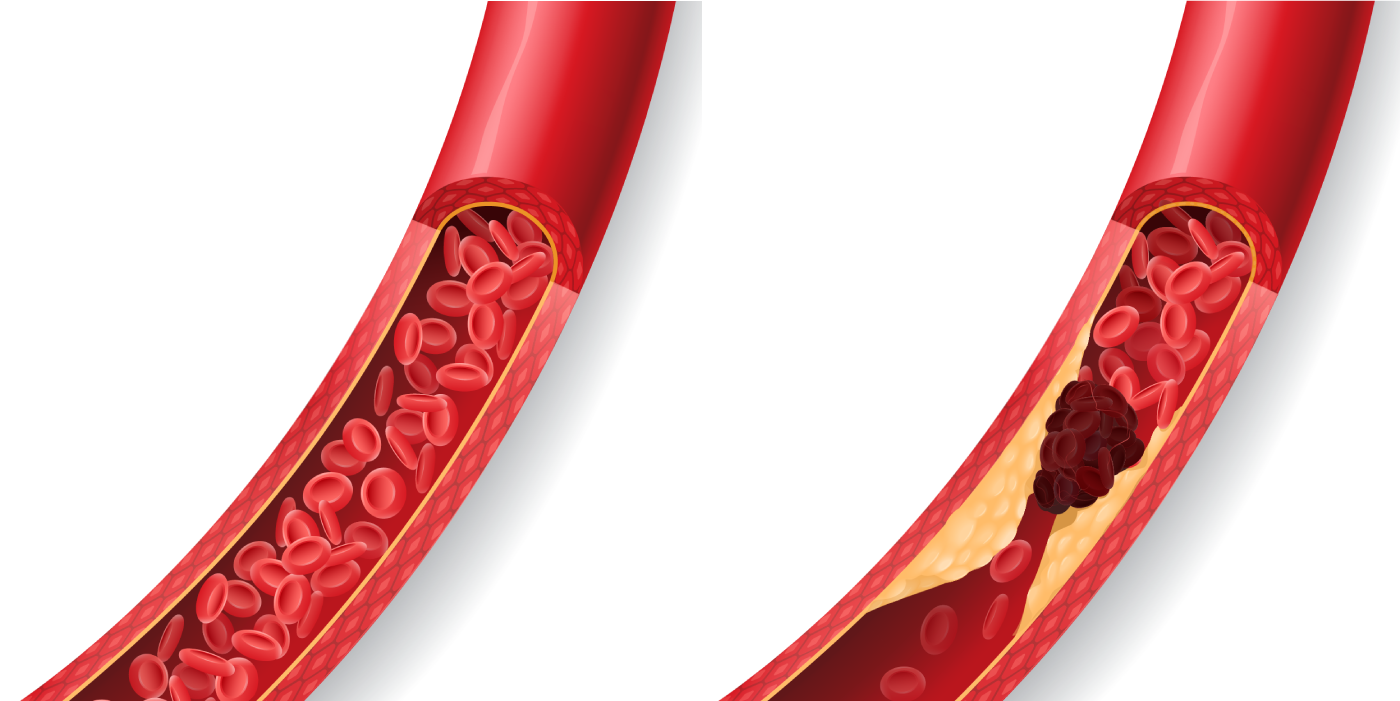 Figure 1: A healthy vs an unhealthy, blocked cerebral blood vessel
How is it treated?
There are two primary treatment options for AIS: administration of Alteplase, a thrombolytic agent, and mechanical thrombectomy, a surgical intervention.
In the event of an ischemic stroke, patients must arrive at the hospital within 4.5 hours of the first symptoms of stroke to be administered intravenous Alteplase, a tissue plasminogen activator (tPA), to dissolve the blood clot and prevent further brain damage (Activase.com). Alteplase is a thrombolytic drug, given as an intravenous drip, that dissolves blood clots and restores blood flow to the brain. This medication is FDA-approved for treating AIS, pulmonary embolism, and acute myocardial infarction.
If the patient has a cerebral embolism (large vessel occlusion), they will need surgical intervention. This surgical procedure requires the doctor to insert a catheter into an artery in the groin, which travels up to the blocked vessel in the brain. Following this, the device removes the clot manually or by suction. This operation can be carried out using either general or local anesthesia. (ASA) (NHS).
What is the current disease landscape?
Many preventative and post-stroke therapeutics are being developed, and they are expected to enter the Acute Ischemic Stroke market in the next decade. The global market size for diagnosing and treating AIS was $5.1B in 2022, and it is projected to reach $9.2B by 2032, growing at a CAGR of 6.1% from 2023 to 2032 (AMS and R&M).
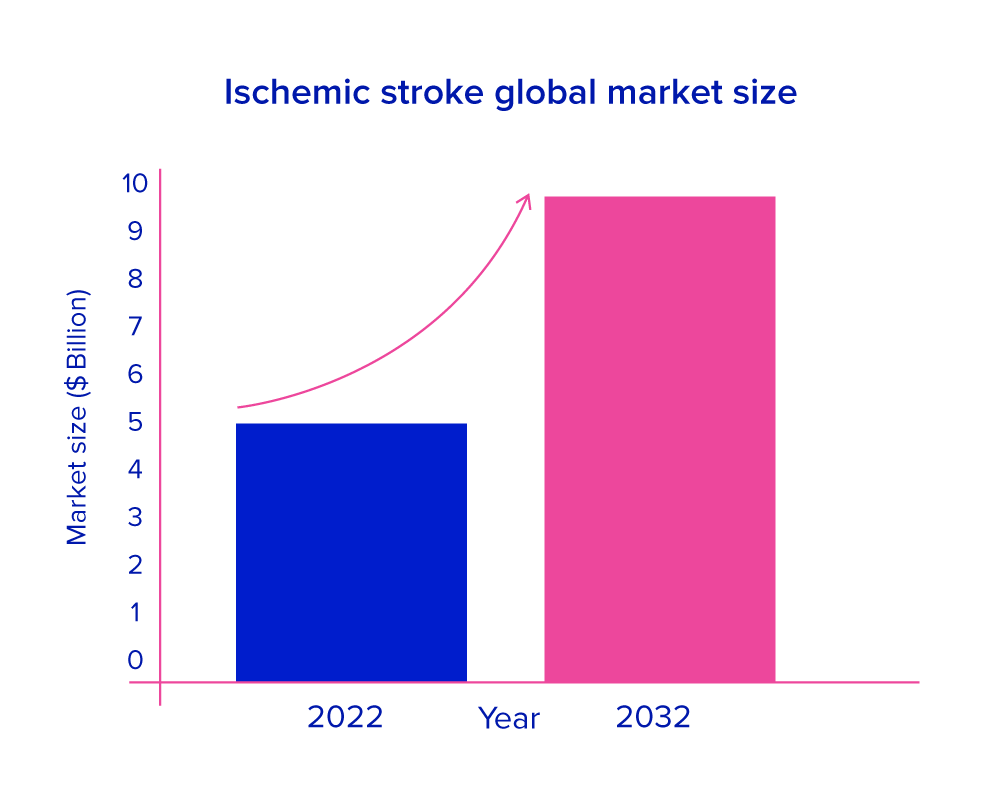 Figure 2: AIS global market size
Although there is a need for immediate stroke treatments, most industry research efforts are focused on preventative care and post-stroke therapies. For example, Bristol-Myers Squibb is developing an investigational drug called Milvexian (BMS-986177) to prevent secondary stroke. Meanwhile, Athersys Inc. is developing its drug candidate, Invimestrocel, which works by “minimizing the activation of the peripheral immune response to the initial injury.” This reduces inflammation in the affected area, resulting in less secondary tissue damage and scarring.
In 2021, Biogen acquired a drug candidate BIIB131 (TMS-007) for Acute Ischemic Stroke from TMS Co., Ltd. This was the only drug in development focused on immediate stroke treatment rather than prevention. It aims to extend the 4.5-hour treatment window to 12 hours post-stroke onset. This drug is a small molecule plasminogen activator and has anti-inflammatory properties, as well as breaking down the blood clots at the site of thrombosis. It had shown promising phase 2a results. However, in 2023, Biogen announced they had decided to pause the Phase 2b study for BIIB131. Ji Xing Pharmaceuticals acquired BIIB131 in January 2024 for global clinical development.
The current treatment option has a short treatment window of only 4.5 hours post-stroke onset of stroke. Many patients cannot reach the hospital within this timeframe. Increasing this time frame could be a game-changer for stroke patients and potentially minimize brain damage following the attack.
DiaMedica Therapeutics, a US company, is working to extend this therapeutic window. They are developing a novel therapy, DM199, that can be administered to stroke patients up to 24 hours of the onset of stroke symptoms. DiaMedica is in a Phase 2/3 clinical trial and has achieved FDA fast-track designation.
Over the past year, we have helped Diamedica improve communications with investors and investigators and clarified the novel mechanism of DM199 via illustrations and animated video, which you can see here.
Acute Ischemic Stroke is a major health problem that requires urgent and effective interventions. Despite the availability of some preventive and rehabilitative therapies, the immediate treatment of AIS has not changed significantly since the approval of Alteplase 30+ years ago. New therapies could potentially improve the outcomes and reduce brain damage and disability in AIS patients. We anticipate the results of the ongoing clinical trials with great interest and hope that they will lead to a paradigm shift in AIS treatment.
About Theoria Creative
Theoria Creative is a fundraising marketing firm for life sciences companies – translating complex science into clear messages, simple graphics, and persuasive stories. We bridge the communication gap for our biotech and life sciences clients, enabling them to clearly and succinctly articulate their unique message and value when raising funds, soliciting partnerships, pitching at roadshows, or presenting to prospective buyers.
View examples of our work here.
Follow us on LinkedIn. Subscribe to our news.