


How to de-risk your science and business strategy for better investment outcomes
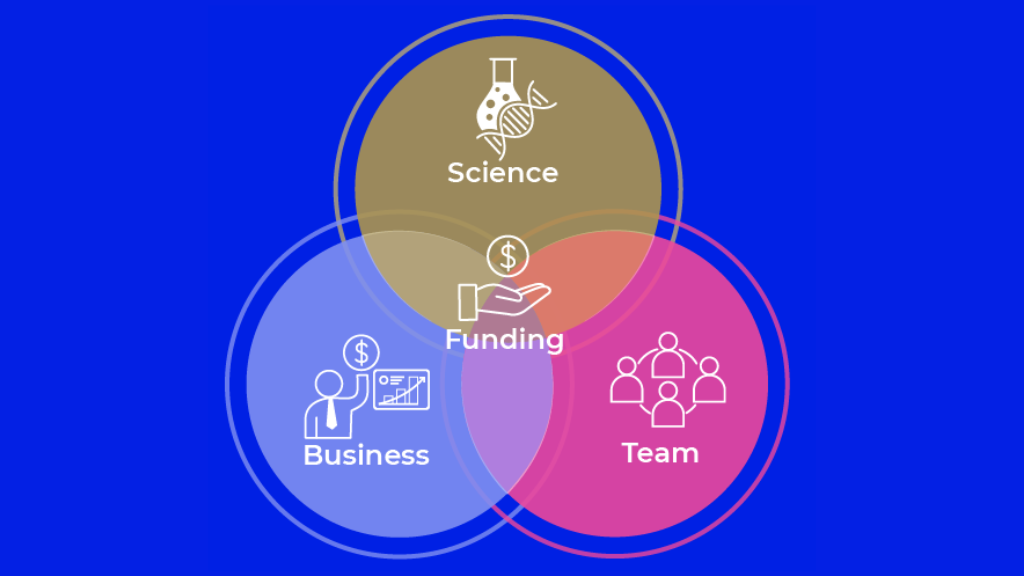
If you are developing an innovative treatment or cutting-edge therapeutics platform, you are familiar with the challenge of raising funds. Biotech and life science companies offer higher ROIs, but also higher investment risks, especially in the early stages. Hence, the challenge – how do you convince investors that your approach is worth the risk?
Investors want to see that your company has a strong foundation. So, crafting a story that helps ‘de-risk’ your science and business strategy can enhance your chances of getting funded.
De-risk your therapeutic approach:
For new science that is relatively early in the drug discovery process, investors may be concerned that there is a lack of data and information to support the safety and effectiveness of your novel therapeutic approach. Is your therapeutic approach trying to improve an existing therapy? Are you coming at the indication via a previously unknown pathway? Whatever your method, you’ll want to put it in perspective because investors aren’t experts in every indication, pathway, or technology.
Help investors put the puzzle pieces together by explaining each step of your process and outlining why you made specific decisions as part of your strategy.
Validate your indication
By validating your indication, you can show investors how your drug addresses a medical need and has a viable market potential. It’s recommended that you define the specific patient population affected by your target disease. This will also help explain why it makes financial and regulatory sense. A clear market opportunity can be demonstrated by providing the prevalence, epidemiology, and current standard of care information for your target disease. These details should be clear, detailed, and verifiable. Don’t forget you should always cite your sources.
Validate the target/therapeutic approach
If your company is improving on an existing therapeutic approach, you can explain how technological developments can present an opportunity to create better drugs that are more cost-effective and efficacious. It is also important to mention how your therapy will improve patients’ quality of life and patient compliance. For example, if the current standard of care is given via injection at a hospital, but your therapy can be given as a pill at home or if it has a reduced dose frequency and/or fewer side effects. By increasing patient compliance, you’ll increase their quality of life.
If your company is going after a novel target or developing a novel therapeutic approach, it is imperative to clearly explain your scientific mechanism and how it is different from therapies in the space. You can justify your approach by citing external resources, academic research, and industry publications that support your scientific direction. You can also explain how your therapy builds upon existing technologies to provide an innovative treatment method. For example, in the case of cell and gene therapies, you can explain how advances in science and technology provide new ways of treating patients.
Validate your platform/technology
Investors want to see why your platform/technology is a secure investment. Therefore, to validate your new platform/technology, you should rely on support from industry experts, scientific advisors, and board members who support your vision for the platform or believe in the effectiveness of your technology. Additionally, you will need to show extensive pre-clinical data (and, if possible, clinical data) to help investors believe this technology or platform will be a success.
De-risk your team:
The process of drug discovery and development is challenging. Although these steps can be expensive and time-consuming, they’re also rewarding, especially for your team, who are responsible for refining your scientific process. Investors need to be confident that you have a strong team who can work efficiently, solve arising issues, and continue moving your therapy toward commercialization.
One of your company’s strengths is the diverse and talented team you have assembled. From the C-suite to the lab, you have engineers, biologists, material scientists, and other experts who bring their skills and experiences to every project. You can demonstrate your company’s longevity by highlighting the past achievements of your team, such as the milestones they have reached and the problems they have solved. For example, demonstrating how your team has optimized the scientific process to enhance quality and lower manufacturing costs. This will show that your team is resilient and can take your therapy from an investigational new drug (IND) to the leading prescribed therapy for the disease.
De-risk your approval strategy:
The nature of regulatory approval can be unsettling and seen as a barrier to investment. For those of us in life sciences, regulatory requirements are omnipresent, and we continually strive to work within their confines as we make adjustments to incorporate them into our workflow. But for many investors, guidance documents are a vague list of rules with an undetermined price tag and no guarantees.
To ease the minds of investors, it helps to point out some of the deliberate decisions your team has made to minimize regulatory risks and lower the cost of compliance. Below are a few examples of ways our clients’ have de-risked their processes:
- incorporated technologies, techniques, or materials that already have regulatory approval
- developed a solution for drug storage and administration that minimizes the burden on clinicians and hospital staff
- built a team with a strong track record of overcoming regulatory challenges
- outlined specific challenges they’ve faced and their team’s adaptability in finding solutions
When presenting to investors, you should define your regulatory pathway by providing a straightforward timeline of the steps and milestones required to get your therapy approved.
De-risk your finances:
With today’s economic climate, investors are interested in fiscally-minded companies. Demonstrating that you’re making financially sound decisions concerning your therapy and business strategy can reassure investors that your company is a good investment.
Financially savvy leadership can manage assets that support growth and absorb the costs of delays inherent in biotech. Building up a runway can be a great way to show your company has some breathing room to remain nimble as it continues to pursue therapeutic solutions.
By explaining how these elements fit together and how you made strategic choices along the way, you can create a unique and memorable narrative that showcases your value and potential and convinces investors that you’re a well-rounded company to invest in.
Tell your story with Theoria Creative
The Theoria Creative team will help you tell your company’s story and your science and de-risk it for investors. We can help you answer the tough questions and put you on the pathway to presenting a successful solution. Contact us to discover how we can transform your science into a complete company profile with cohesive communication materials.