



An effective biotech pitch deck, or corporate slide deck, needs to sell both your science and your company to potential investors.
To help you craft a clear, persuasive deck that delivers results, we’re sharing a series of proven Theoria Creative strategies and templates as a guide. This article is part of From Science to Investment: Theoria’s Guide to an Effective Biotech Pitch Deck, a series dedicated to breaking down each essential component of a winning pitch deck. In earlier installments, we covered the pipeline slide, the team slide, the disease overview, the milestone slide, and most recently the investment summary. Now we focus on the trial design slide, the part of your story that moves from safe dosing to decision points that prove value.
Complete the form at the bottom of this article to request our free PowerPoint file with a trial design slide template!
Trial design is not just a diagram. It is a clear, visual plan that builds credibility, links readouts to value inflection points, and shows why your ask and timing make sense. Used well, this slide answers three questions at once. What are you testing, in whom, and when will you know the answer.
There is a logic to how people process this information. Start with who can enroll. Then show the sequence of procedures and dosing. Close with objectives and endpoints. Many teams flip this order or mix in results, which makes the slide hard to follow. The structure below keeps the story clear across modalities, whether you are presenting small molecules, biologics, cell therapy, or gene therapy.
The trial design slide: three parts that make it work
A clear trial design slide follows a logical sequence. Regardless of therapeutic area or trial phase, the goal is the same, to make complex information instantly understandable. At Theoria Creative, we approach every design slide using a consistent structure that helps investors follow the logic and stay focused on the story.
There are three essentials every effective trial design slide should include, always in this order:
1) Patient selection criteria
Begin with who is eligible for the study. State the essentials that shape how results will be interpreted. Age range, biomarker or mutation status, prior lines of therapy, performance status, and key exclusions belong here. In high-need settings, many trials enroll challenging populations such as later-line patients with limited treatment options. Stating this clearly helps investors understand the bar your program must clear and sets context for everything that follows.
Keep this section concise. Use short phrases rather than sentences so a reader can scan the criteria quickly. Put the most influential criteria first. Until your audience knows who you are studying, the rest of the slide will not land.
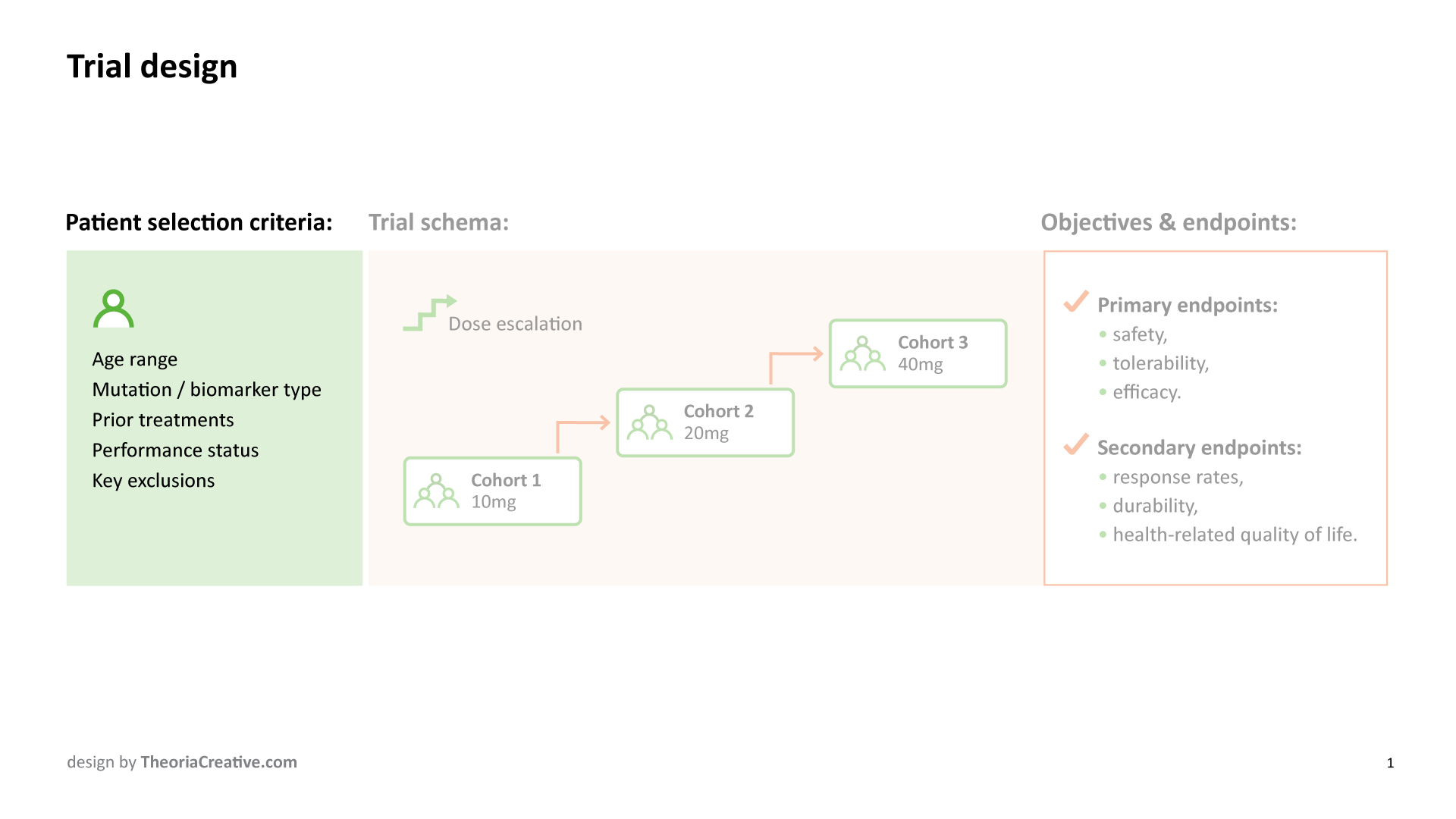
Patient selection criteria appear first to anchor the rest of the slide.
2) Trial schema
Next, show the plan. Use a clean diagram that maps the steps of the study in order. Procedures, timing, dosage, cohort structure, and follow-ups should be clear at a glance. For cell and gene therapies include collection, manufacturing, pre-treatment.
For drug studies you may want to include any combination arms. If the study includes expansion cohorts, present them as parallel arms at the selected dose. The goal is a simple sequence that explains what will happen and when.
Stick to one consistent time scale. Label only the steps that drive decisions. Avoid mixing results or narrative comments into the schema. If new findings require updates to the plan, reflect those changes on a separate results slide, not here. The design slide explains the plan. The results slide explains what happened.
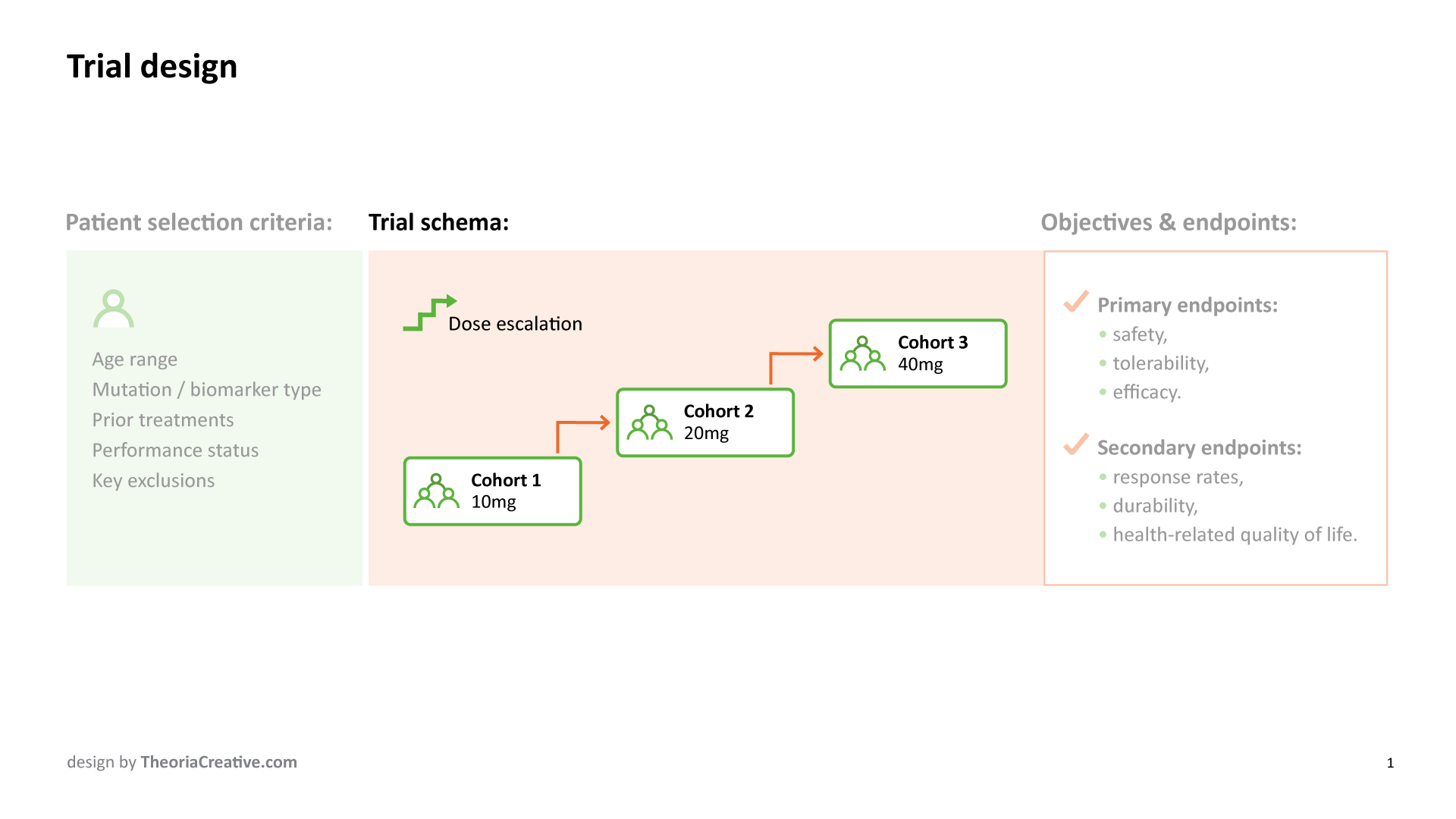
A clear sequence of steps that explains what will happen and when.
3) Objectives and endpoints
Close the slide with what you intend to learn. Primary endpoints should state the main question for the phase, for example: safety and tolerability or a defined efficacy signal. Secondary endpoints can cover supportive measures, for example: response rates, durability, health-related quality of life.
Place primary endpoints first, then secondary. Keep this section as a short right-hand list that visually balances the criteria column on the left. Objectives answer why each step in the schema exists and how decisions will be made.
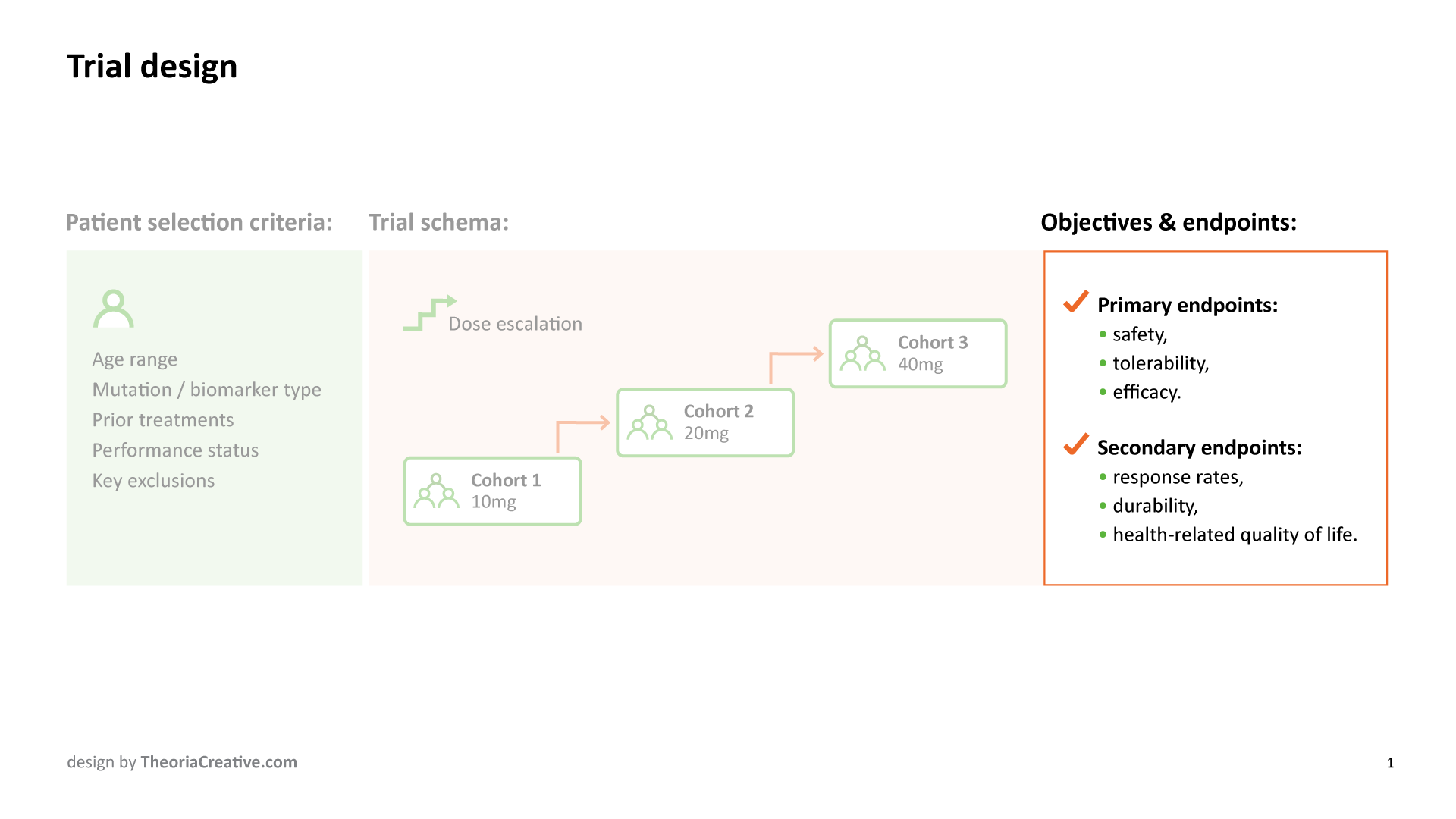
Primary and secondary endpoints clarify why each step exists.
Keep the plan separate from the results
Many trial design slides become hard to follow because they mix the schema with outcome commentary. You see arrows crisscrossing the page with notes like “in Cohort 1 we observed X, so we changed Y.” That is a different conversation. Use the trial design slide to explain what you will do, or what was planned. Use a separate slide to summarize what happened and how the plan evolved. Clarity comes from simplicity.
Present your clinical plan with clarity and confidence
The trial design slide is more than a study diagram. It is a strategic view of how your program reaches decision points that matter. By showing who you will study, what will happen, and why those steps matter, you help investors follow your path and funding logic.
Fill in the form below to receive our free file with a trial design template. Use it to build a slide that fits your study while keeping the logic clear.
Have questions or want an expert to review your pitch deck? Contact us, we’re happy to help. Our team has years of experience crafting impactful investor narratives and visuals to develop powerful corporate decks that drive funding.
Good luck, and happy fundraising!