


Growing biotech companies require significant investment to stay afloat. Often, confidence in a company’s potential hinges on the clarity and persuasiveness of their biotech pitch deck.
At Theoria Creative, we carefully consider each slide when we develop investor presentation decks for clients. Every word, graphic, and high-level message is strategically chosen to deliver a compelling and impactful story.
Based on our experience creating pitch decks and other scientific marketing materials, we understand the common challenges that companies face when crafting their investor-facing communication. That’s why we’re excited to bring you From Science to Investment: Theoria’s Guide to an Effective Biotech Pitch Deck, a new article series dedicated to breaking down each essential component of a winning pitch deck to help you overcome some of the biggest hurdles. In it, we break down the most common slides of an investor pitch deck, share our proven strategies, and offer actionable advice and templates for crafting a pitch deck that stands out to investors.
First up? Let’s dive into the crucial Pipeline Slide and discuss some ways to make the most out of it, showcasing your company’s potential and attracting investors in the process.
Complete the form at the bottom of this article to request our free PowerPoint file with 7 pipeline templates and one slide with icons!
Your company’s value proposition in one visual snapshot
We believe the pipeline slide offers a unique opportunity to highlight your company’s value and paint a compelling picture for investors.
The pipeline slide is frequently underutilized in biotech investor presentations. Many drug development companies simply list programs and progress, and speakers often rush through this section during presentations. This can inadvertently signal a lack of confidence in the company’s trajectory, leaving the audience with lingering questions.
No matter what development stage a company is in, there is always a desire to be further along. A pre-clinical company prefers to be in the clinic and have more programs to show in their pipeline. An early clinical company wants to be in Phase 3, impressing investors with their swift progress. And companies that are in Phase 3 rush through their pipeline slide because they can’t wait to show off their clinical data.
With a few strategic additions, the pipeline slide can become much more than just a progress report. It can be a visual snapshot of your company’s value proposition, highlighting your unique strengths and potential of your programs.
Below are some tips to help you get the most out of your life sciences pipeline slide when preparing your corporate slide deck for investor presentations.
Emphasize market opportunity
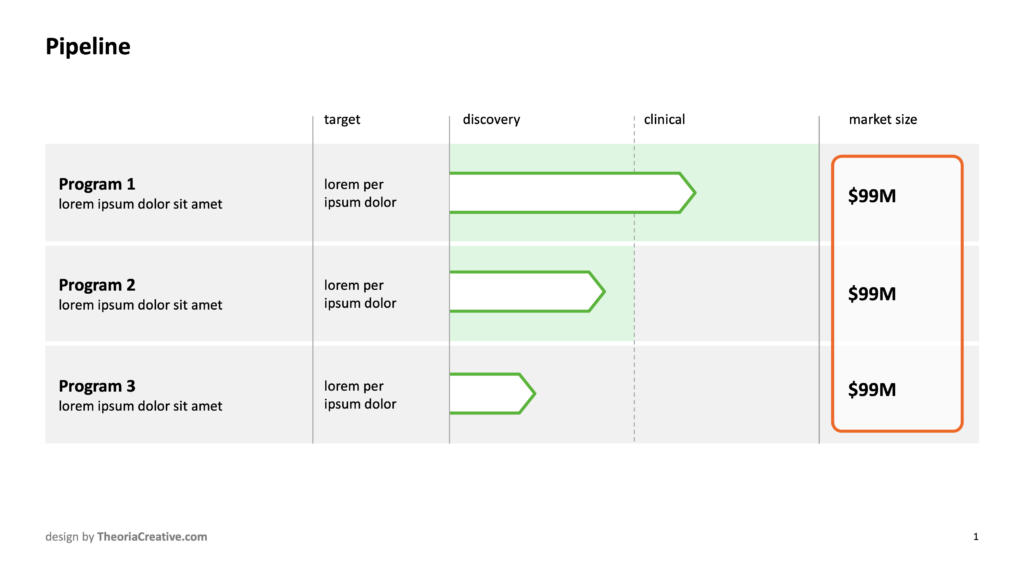
Sometimes the most impactful message to deliver via the pipeline slide is the market opportunity itself. By emphasizing the size and unmet need within a specific market, you effectively signal the potential return on investment for a particular indication or therapy.
Perhaps your company is in the early clinical stages and there isn’t much more to report. Maybe it’s the opposite, your company is entering Phase 3 and you want to stress to investors that this is a prime opportunity to get involved before the stock price potentially climbs.
In either case, we recommend adding a column to the right side of the pipeline table for market numbers as shown in the example below. In addition, if market opportunity is the only significant point on the slide, we’ll also use color to highlight the column. However, if there is other valuable information to emphasize, then we keep Market Size column simple.
Offload extra information
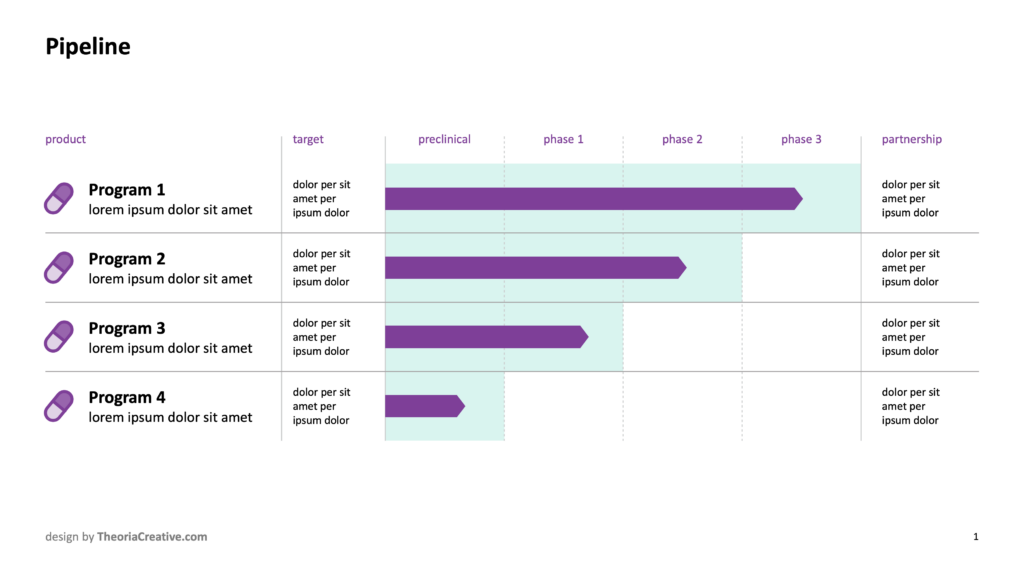
If your company has a complex story or complicated clinical data to communicate in the lead program slides, use the pipeline slide to offload that information.
Some information, while important, is just not worthy of an entire slide, yet it still needs to be mentioned. This auxiliary information such as the molecule’s name, product development partnership, technology particulars, or targeted disease categories often get included, haphazardly, throughout the slide deck, becoming a distraction and diluting the core message being delivered.
If this auxiliary information is not the primary message of your slide, it is best positioned on the left side of the pipeline. If this information is significant — for example, a drug development partnership with a large, well-known pharma company — then you’ll want to place it on the right side of the pipeline, referring to it as you conclude your pipeline slide talk track.
Adjust visuals for impact
Visuals can help viewers associate information with the feeling you’re trying to convey.
Do you want your audience of potential investors to feel that you’ve come a long way in your program development, (even if you are still an early stage)? Use longer horizontal progress bars in your pipeline table and make the phase columns wider, as shown in our example below.
Line thickness also helps communicate rapid development and potential success. But at Theoria Creative, we only use thick or heavy lines in the progress bars when program development is the sole or main message of the pipeline slide.
And finally, if you have something important you’d like to emphasize on your life sciences pipeline slide use icons to stress its relevance. If your company has earned orphan drug designation, filed an IND or received FDA approval, add a graphic on the right side of the slide to maximize impact.
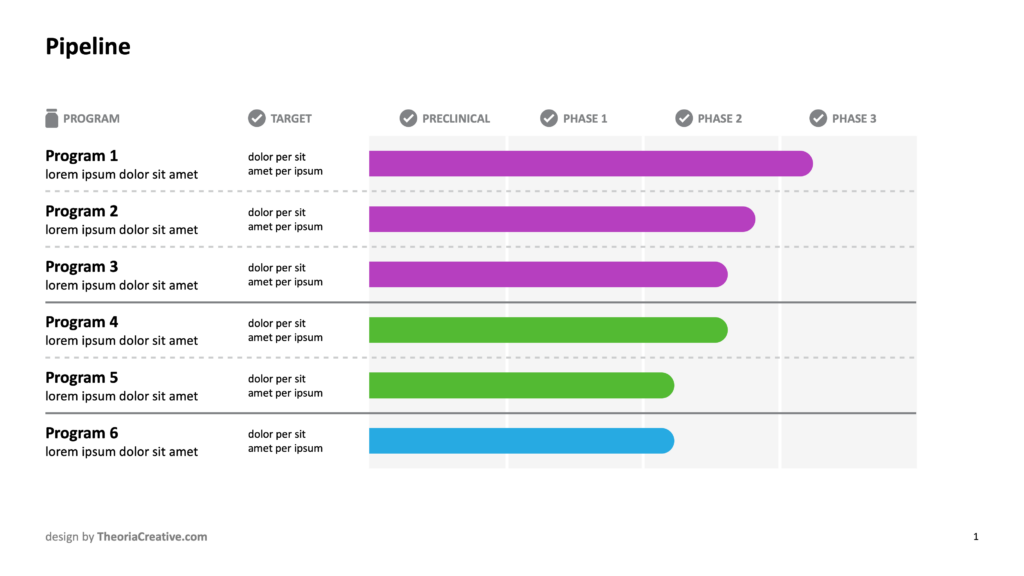
The versatility of the pipeline slide can’t be overstated. It illustrates technical progress, highlights market opportunity, and ties up loose ends, all while maintaining visual interest. Give this slide some extra time during your presentation, and let it do some of the heavy lifting it is capable of.
Fill in the form below to receive our free file with 7 pipeline slide templates and one slide with pipeline icons. Mix and match elements from each to create a pipeline that best represents your company’s program development.
Have questions or want us to review your current investor pitch deck? Contact us — we are happy to help. Our team has years of experience creating meaningful content and simple visuals to develop powerful corporate presentation decks that raise funds.